Save 1,550 SAR

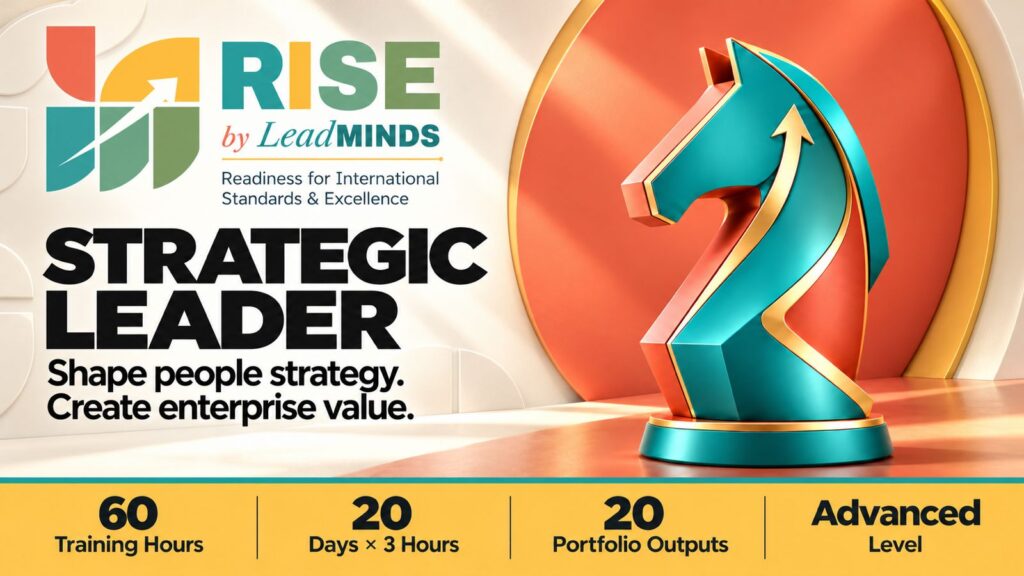
- Duration60 hours
- Language Arabic with English Terminology
Overview
Strategic HR leadership means turning business strategy into HR priorities and initiatives that deliver organizational goals and create value.
RISE Strategic Leader is the third and highest level of the RISE qualification series — Readiness for International Standards & Excellence. The program equips HR leaders to translate business strategy into an integrated HR strategy, align HR functions and practices with organizational goals, evaluate strategic options, influence executive decisions and build sustainable organizational capability.
Over twenty training days, the program covers the strategic business context, HR strategy, strategic workforce planning, analytics for executive decisions, talent management and succession, the employee value proposition and experience, rewards, performance management, capability development, organizational culture and change leadership — culminating in a capstone project in which participants present an integrated HR strategy to an executive panel.
Each three-hour session includes a strategic issue discussion, an executive case analysis, a decision-making simulation and practice questions for the target certification. By the end of the program, participants hold an integrated Strategic People Leadership Portfolio of twenty deliverables, a readiness assessment report and a targeted study plan.
What Will You Learn?
- Analyse how HR leadership contributes to enterprise value, governance, the operating model and strategy execution.
- Interpret business models and competitive choices and translate their implications into clear HR priorities.
- Assess external, technology and AI trends and workforce risks, and build responses for future capabilities.
- Design an integrated HR strategy and prepare compelling business cases for stakeholders.
- Lead strategic workforce planning, compare scenarios and make a defensible recommendation.
- Use advanced HR analytics and financial evidence to shape executive insights and recommendations that support decision-making.
- Develop a talent philosophy, a succession planning framework and a leadership pipeline with fair governance and calibration.
- Develop the employee value proposition (EVP), employee experience and targeted retention strategies for critical talent.
- Align rewards, performance, learning and organizational capability with strategy and financial sustainability.
- Diagnose organizational culture, lead change and transformation, and defend an integrated strategy before an executive panel.
Course content
Module 1: Strategic Role of HR Leadership
- Value creation and strategic HR leadership.
- Operating models and governance; professional courage and conflicting interests.
- Executive leadership expectations.
Module 2: Business Models & Strategic Alignment
- Business model logic, competitive advantage and operational requirements.
- Implications of strategic choices.
- Measures of enterprise value.
Module 3: External Environment & Local Context
- Advanced PESTLE analysis and market scanning.
- The Saudi and Gulf workforce context; regulatory, cultural and demographic implications.
- International standards and local choices.
Module 4: Future Trends, Technology & Workforce Risk
- Automation and augmentation; emerging skills and work models.
- Responsible AI and data risk.
- Workforce resilience.
Module 5: HR Strategy Framework
- The components of strategy.
- Diagnosis and choices; trade-offs and prioritization.
- Metrics and accountability.
Module 6: Stakeholders, Governance & Business Cases
- Influence and interest mapping; decision rights and governance.
- Financial logic and returns.
- Risks, alternatives and executive communication.
Module 7: Strategic Workforce Planning
- Planning horizons.
- Supply and demand modelling; critical capabilities and roles.
- Strategic workforce risks.
Module 8: Workforce Scenarios, Segmentation & Options
- Scenario assumptions and workforce segmentation.
- Cost, risk, speed and sustainability.
- Decision criteria.
Module 9: Strategic HR Analytics
- Analytics maturity, from descriptive to prescriptive.
- Causality, bias and data ethics.
- Business-linked metrics.
Module 10: Executive Insight, Financial Evidence & Decisions
- Productivity and workforce cost; cost, return and scenario sensitivity.
- Executive data visualisation.
- Framing the recommendation and the decision.
Module 11: Talent Philosophy & Critical Talent
- Talent philosophy, critical roles and pivotal talent.
- Potential, performance and readiness.
- Calibration and governance.
Module 12: Succession Planning & Leadership Pipeline
- Succession depth and coverage; readiness and development experiences.
- The leadership pipeline.
- Risk, diversity and governance.
Module 13: Employer Positioning & EVP
- Talent market intelligence and competition for talent.
- Employer brand and reputation; the employee value proposition (EVP).
- Target talent segments and evidence.
Module 14: Employee Experience, Engagement & Retention
- Employee journeys and moments that matter; engagement, trust and commitment.
- Undesirable turnover.
- Retention strategies for specific employee segments.
Module 15: Strategic Reward & Job Architecture
- Reward philosophy, job architecture and evaluation governance.
- Market positioning, total rewards and behavioural impact.
- Financial sustainability of reward costs.
Module 16: Strategic Performance & Accountability
- Performance philosophy, organizational alignment and calibration.
- Leader and manager capabilities.
- Fair differentiation of performance levels and its governance.
Module 17: Organizational Learning & Future Capability
- Future capability architecture and learning culture.
- Leadership development, career and capability pathways.
- Impact and investment metrics.
Module 18: Culture & Organizational Effectiveness
- Culture diagnosis, the Schein model and organizational systems.
- Leadership signals and employee experience.
- Organizational effectiveness metrics.
Module 19: Leading Change & Transformation
- Change strategy and model choice; stakeholder alignment and resistance.
- Communication, capability and reinforcement.
- Transformation risks and metrics.
Module 20: Strategic Capstone & Executive Presentation
- Context and HR risks; workforce, talent, rewards, performance, capability, culture and change.
- Governance and metrics; a 90-day and 12-month roadmap.
- Presenting and defending the strategy before an executive panel, followed by the 120-question timed knowledge assessment and the mock exam.
Who is this course for?
- HR Managers and Directors.
- Strategic HR Business Partners.
- CHROs and Heads of HR.
- Anyone preparing for the SPHRi® or SHRM-SCP® certification.
- The program can also be delivered in-house for an organization’s HR leadership team.
Course materials
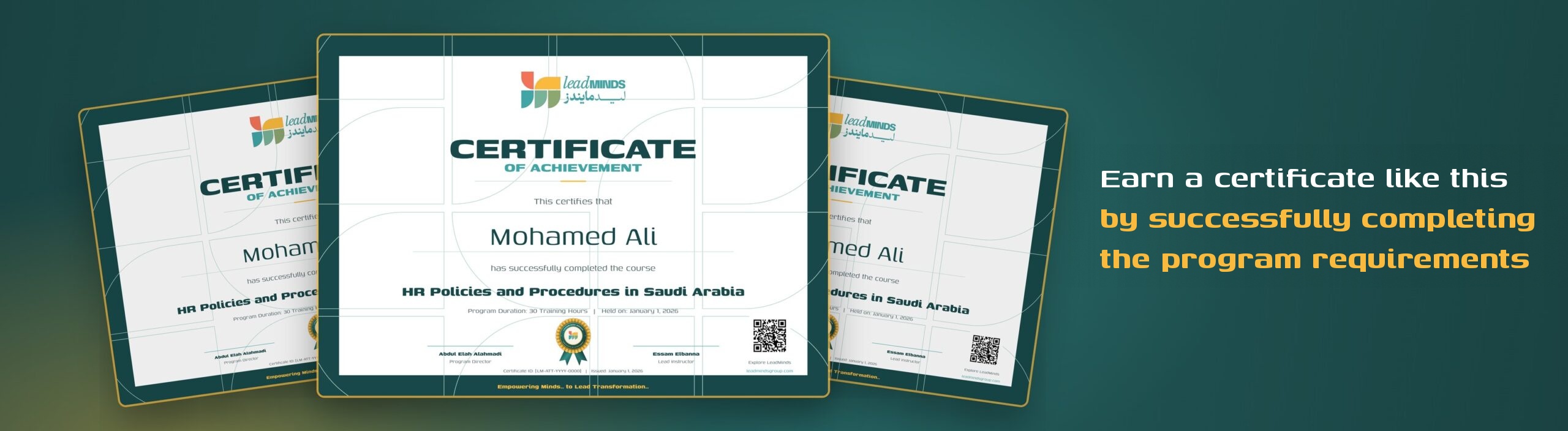
Certificate of completion
FAQ
1. When will my registration be confirmed?
Registration is confirmed once all program requirements have been met, full payment has been received, and seats are available.
2. What are the requirements to receive a Certificate of Completion?
Participants must attend at least 75% of the total training hours and complete the Strategic People Leadership Portfolio (twenty deliverables), the executive simulations and evidence-based strategic tasks, the integrated strategy with a governance framework, metrics and implementation roadmap, the 120-question timed knowledge assessment and the SPHRi® or SHRM-SCP® mock exam.
3. Can I cancel my registration and request a refund?
Yes, subject to the following conditions: 5 or more calendar days before the program starts: A full refund, less any non-refundable payment processing fees, if applicable. Less than 5 days before the program starts or in the event of a no-show: A 50% deduction from the program fees, subject to any additional non-refundable third-party charges. After attending more than 50% of the program hours: No refunds, deferrals, or transfers of registration are permitted.
4. Can I defer my registration to another date?
Yes, subject to seat availability and scheduled program dates: - 5 or more calendar days before the program starts: No additional fees. - Within the 4 calendar days preceding the program start date: A 10% administrative fee applies. - Deferrals are permitted only once and are not available after attending more than 50% of the program hours.
5. Can I retain my fees as training credit?
Yes. Participants may request to convert the refundable amount, as determined under the Refund Policy, into training credit valid for 12 months from the date of approval. Registration fees may be transferred to training credit only once, and the credit is non-transferable to another individual.
6. What happens if LeadMinds cancels the program?
Participants may choose between: - A full refund of the program fees paid, without any deductions by LeadMinds. - Converting the full amount paid into training credit toward another program.
7. Can I receive a refund if I paid through Tamara?
Yes. Refunds are processed in accordance with the Cancellation and Refund Policy, subject to the deduction of any non-refundable installment or processing fees under the payment provider's terms and conditions.
8. How long does it take to receive a refund?
Refund processing times vary depending on the payment method: - Mada and credit cards: Typically 7–14 business days. - Tamara and JeelPay: 3–21 business days, depending on the payment provider's procedures.
9. How can I submit a cancellation, refund, or deferral request?
Requests must be submitted in writing to info@leadmindsgroup.com, including the participant's name, program name, registration details, and reason for the request. The LeadMinds team typically reviews and responds to requests within 2–3 business days.
10. How does LeadMinds protect my personal data?
LeadMinds is committed to protecting personal data in accordance with the Saudi Personal Data Protection Law (PDPL). Personal data is used only for purposes necessary to provide services, process registrations, issue certificates, and communicate with participants. LeadMinds does not sell personal data to third parties.