Save 1,250 SAR

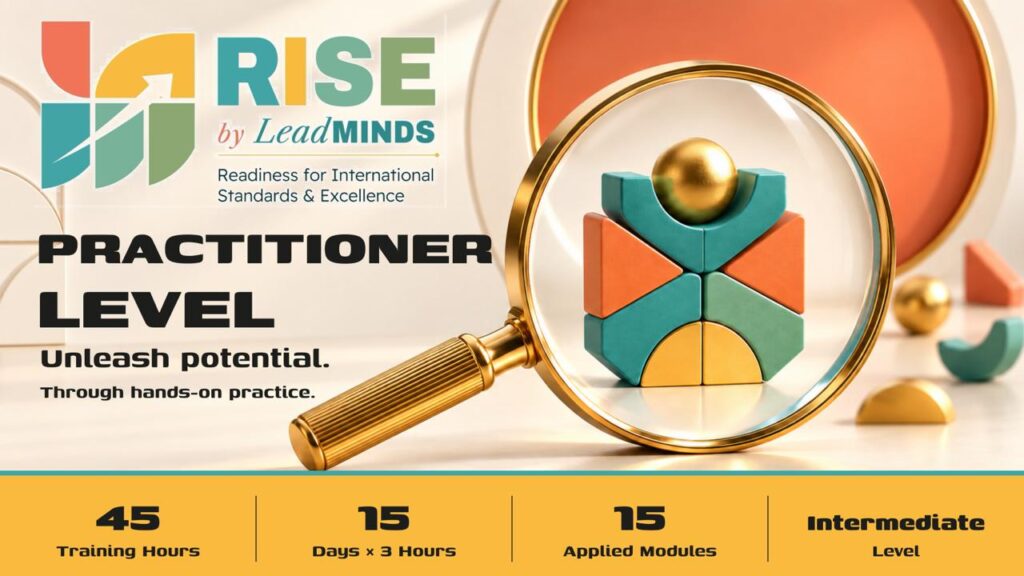
- Duration45 hours
- Language Arabic with English Terminology
Overview
Effective professional practice begins when knowledge turns into practical, defensible solutions and deliverables.
RISE Practitioner is the second level of the RISE qualification series — Readiness for International Standards & Excellence. The program equips participants to use HR tools and practices competently and independently, analyse evidence, solve operational HR problems and make practical, actionable recommendations.
Over fifteen training days, participants move from evidence-based diagnosis to producing integrated, ready-to-use professional deliverables: job analysis and documentation, sourcing and structured selection, workforce planning, people analytics, retention, job evaluation, rewards, performance management and capability development — culminating in an integrated applied case presented to a panel of practitioners and specialists.
Each training day is a single three-hour session combining a focused conceptual input, an applied workshop, a case study or simulation, and a question lab for the target certification. By the end of the program, participants leave with an HR Practitioner Toolkit of fifteen professional deliverables and a readiness report for their certification path.
What Will You Learn?
- Apply professional standards to real cases, adapting global practices to the local context without compromising their principles.
- Identify HR problems from business evidence and distinguish symptoms from root causes.
- Plan and conduct job analysis and produce accurate, evidence-based job documentation.
- Prepare a targeted sourcing plan and choose channels based on labour market evidence.
- Design and run structured selection, make a defensible hiring decision and design an effective onboarding program.
- Translate plans into workforce requirements and propose practical actions to close gaps.
- Analyse HR data and communicate insights, diagnose the causes of undesirable turnover and propose targeted retention actions.
- Evaluate jobs using a defined methodology and make a balanced reward recommendation that uses market data while maintaining internal equity.
- Apply continuous performance management practices, address underperformance objectively and fairly, and design development plans and measure their impact.
- Integrate HR practices and disciplines to deliver practical, integrated solutions, and practise case-based and situational judgment certification exam questions.
Course content
Module 1: Professional Practice & Local Application
- Evidence-based decisions, ethical decision-making and documentation.
- Adapting international standards to local application requirements.
- Stakeholder communication.
Module 2: Applied Business & HR Diagnosis
- Operational requirements and stakeholder interviews.
- Gathering evidence.
- Root-cause analysis and problem framing.
Module 3: Applied Job Analysis
- Choosing the analysis method.
- Job analysis interviews, questionnaires and observation.
- Validation and quality assurance.
Module 4: Job Documentation & Design
- Job purpose and outputs, responsibilities and accountabilities.
- Competencies and person specifications.
- Job enrichment, enlargement and rotation, and bilingual documentation.
Module 5: Talent Attraction & Sourcing
- The sourcing brief, and internal and external sources.
- Employer positioning and the employee value proposition (EVP).
- Choosing channels, job advertisements and metrics.
Module 6: Structured Selection & CBI
- Selection and screening criteria, and the competency-based interview guide.
- Probing with the STAR/STARR method.
- Recording evidence, rating, bias and records.
Module 7: Assessment, Decision-Making & Onboarding
- Work samples and tests, candidate assessment matrices and rating calibration.
- Making a defensible decision.
- Job offers, candidate communication and onboarding metrics.
Module 8: Operational Workforce Planning
- Supply and demand, gap analysis and critical roles.
- Build, buy, borrow, redeploy, retain and automate.
- Action ownership and metrics.
Module 9: Applied People Analytics
- Data sources and data quality.
- Turnover, absence, hiring, performance and learning metrics.
- Descriptive and diagnostic analysis, visualisation and one-page reports.
Module 10: Retention & Employee Experience
- Healthy and unhealthy turnover.
- Stay and exit interview evidence, and employee experience touchpoints.
- Internal mobility and the manager effect.
Module 11: Applied Job Evaluation
- The purpose and governance of job evaluation; ranking, classification and point-factor methods.
- Compensable factors, weighting and scoring.
- Panel calibration and documentation.
Module 12: Applied Total Rewards
- Reward diagnosis, salary surveys and market positioning.
- Salary structures, incentives, benefits and recognition.
- Financial sustainability of reward costs, risk management, pay equity and communication.
Module 13: Applied Performance Management
- Aligning goals and KPIs across organizational levels.
- Regular check-ins, feedback and documentation.
- Skill, motivation, process and resource gaps; improvement plans and calibration.
Module 14: Learning & Capability Development
- Organizational, team and individual needs; adult learning and choosing the approach.
- Coaching, mentoring, blended learning and learning in the flow of work.
- Kirkpatrick’s four levels of training evaluation and measuring impact on performance.
Module 15: Integrated Practitioner Case
- Business and HR diagnosis, workforce and job requirements.
- Sourcing, rewards, performance and capability; local adaptation, metrics and implementation.
- Presenting the solution to a panel of practitioners and specialists, followed by the 90-question timed knowledge assessment and mock exam preparation.
Who is this course for?
- HR Specialists.
- HR Generalists with mid-level experience.
- HR Supervisors.
- Anyone preparing for the PHRi®, SHRM-CP® or CHRM certification.
- The program can also be delivered in-house for an organization’s HR team and tailored to its needs.
Course materials
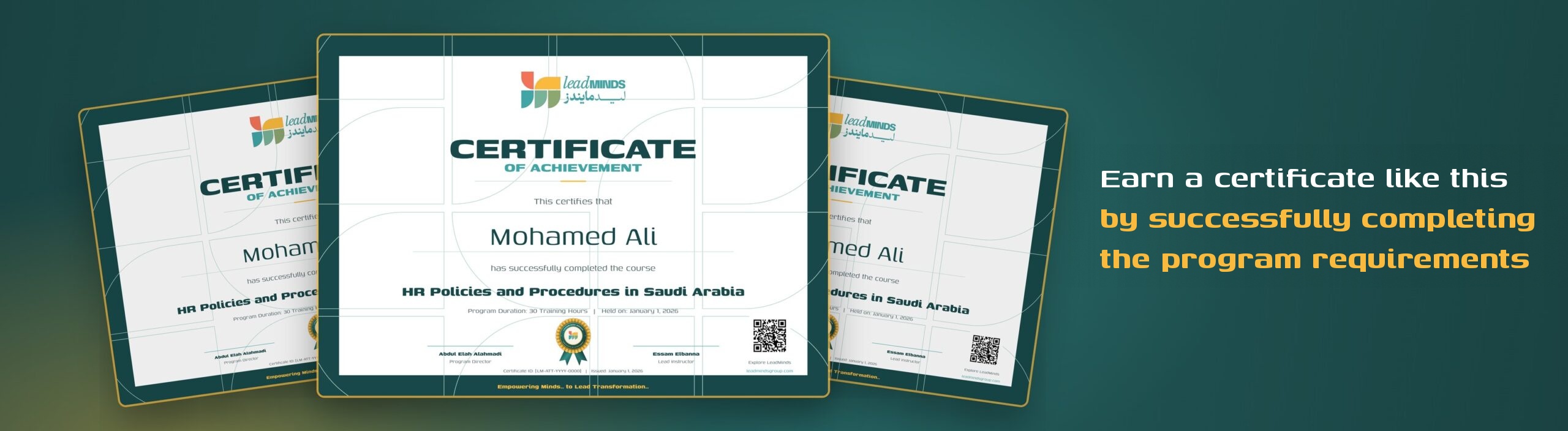
Certificate of completion
FAQ
1. When will my registration be confirmed?
Registration is confirmed once all program requirements have been met, full payment has been received, and seats are available.
2. What are the requirements to receive a Certificate of Completion?
Participants must attend at least 75% of the total training hours and complete the Practitioner Toolkit (fifteen professional deliverables), the trainer-observed simulation, the integrated case and implementation presentation, the 90-question timed knowledge assessment and the mock exam for their chosen certification.
3. Can I cancel my registration and request a refund?
Yes, subject to the following conditions: 5 or more calendar days before the program starts: A full refund, less any non-refundable payment processing fees, if applicable. Less than 5 days before the program starts or in the event of a no-show: A 50% deduction from the program fees, subject to any additional non-refundable third-party charges. After attending more than 50% of the program hours: No refunds, deferrals, or transfers of registration are permitted.
4. Can I defer my registration to another date?
Yes, subject to seat availability and scheduled program dates: - 5 or more calendar days before the program starts: No additional fees. - Within the 4 calendar days preceding the program start date: A 10% administrative fee applies. - Deferrals are permitted only once and are not available after attending more than 50% of the program hours.
5. Can I retain my fees as training credit?
Yes. Participants may request to convert the refundable amount, as determined under the Refund Policy, into training credit valid for 12 months from the date of approval. Registration fees may be transferred to training credit only once, and the credit is non-transferable to another individual.
6. What happens if LeadMinds cancels the program?
Participants may choose between: - A full refund of the program fees paid, without any deductions by LeadMinds. - Converting the full amount paid into training credit toward another program.
7. Can I receive a refund if I paid through Tamara?
Yes. Refunds are processed in accordance with the Cancellation and Refund Policy, subject to the deduction of any non-refundable installment or processing fees under the payment provider's terms and conditions.
8. How long does it take to receive a refund?
Refund processing times vary depending on the payment method: - Mada and credit cards: Typically 7–14 business days. - Tamara and JeelPay: 3–21 business days, depending on the payment provider's procedures.
9. How can I submit a cancellation, refund, or deferral request?
Requests must be submitted in writing to info@leadmindsgroup.com, including the participant's name, program name, registration details, and reason for the request. The LeadMinds team typically reviews and responds to requests within 2–3 business days.
10. How does LeadMinds protect my personal data?
LeadMinds is committed to protecting personal data in accordance with the Saudi Personal Data Protection Law (PDPL). Personal data is used only for purposes necessary to provide services, process registrations, issue certificates, and communicate with participants. LeadMinds does not sell personal data to third parties.