Save 1,000 SAR

- Duration30 hours
- Language Arabic with English Terminology
Overview
Accurate knowledge is the starting point for every confident professional practice.
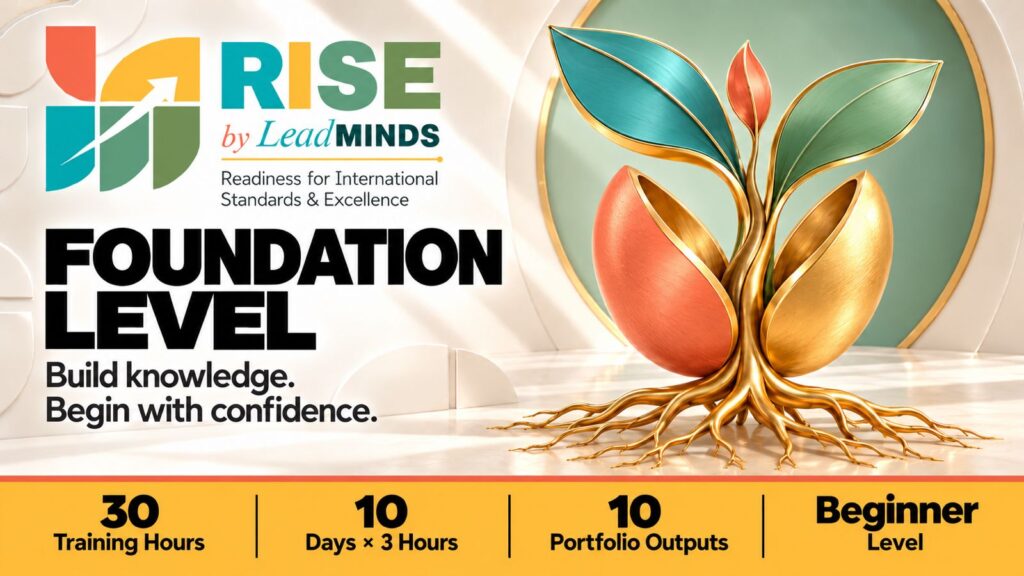
RISE Foundation is the first level of the RISE qualification series — Readiness for International Standards & Excellence. The program builds the professional knowledge, behaviours, language and core concepts participants need to work effectively in an early-career HR role, and to start preparing with confidence for the international aPHRi® certification.
Over ten training days, participants explore the purpose and roles of HR, professional ethics, the Saudi and Gulf business and employment context, the employee lifecycle, job analysis, recruitment and selection, workforce planning, total rewards, and performance, learning and talent — through Saudi and Gulf cases while keeping standard international terminology.
Each training day is a single three-hour session combining clear explanation, a guided applied example, a practical activity and exam-style question practice. By the end of the program, participants leave with a portfolio of ten practical deliverables, a readiness report and a personal study plan.
What Will You Learn?
- Explain the purpose and evolution of HR, its roles and its main functional areas.
- Apply core ethical principles and identify behaviours that build trust and professional credibility.
- Identify the internal and external factors that shape the business environment and the impact of the local context on HR practice.
- Distinguish between organizational culture and climate, and explain employee engagement and basic responses to change.
- Describe the stages of the employee lifecycle and HR responsibilities at each stage.
- Explain the purpose and methods of job analysis and the components of sound job documentation.
- Explain the recruitment and selection process and fair, structured selection practices.
- Explain workforce supply, demand and gaps, and read core HR metrics.
- Identify the components of total rewards and explain internal equity and external competitiveness.
- Explain continuous performance management and choose the right development approach for a specific performance gap.
Course content
Module 1: HR Profession & Organizational Contribution
- The purpose and evolution of HR, and an overview of Ulrich’s HR roles.
- HR’s contribution to organizational results.
- International standards and local expectations.
Module 2: Ethics & Professional Behaviours
- Confidentiality, fairness, consistency and transparency.
- Professional courage and influence; inclusion, relationships and communication.
- Evidence-based practice and reflection.
Module 3: Business & Local Employment Context
- Business model basics, the VUCA environment and PESTLE analysis.
- Characteristics of the Saudi and Gulf labour market.
- Culture, policies and local application.
Module 4: Culture, Engagement & Change
- Schein’s levels of organizational culture.
- Employee engagement and employee experience.
- Change readiness and resistance, with an overview of the Lewin, Kotter and ADKAR models.
Module 5: Employee Lifecycle
- From recruitment to separation.
- Candidate and employee experience; fairness and consistency.
- Records, communication and privacy.
Module 6: Job Analysis & Documentation
- Analysis methods: interviews, observation, questionnaires and document review.
- Duties, responsibilities and accountabilities.
- Job descriptions, person specifications and competencies.
Module 7: Recruitment, Selection & Onboarding
- Internal and external sourcing, job advertisements and selection criteria.
- Structured and competency-based interviews using the STAR/STARR method.
- Bias, communication and onboarding.
Module 8: Workforce Planning & People Data
- Internal and external labour markets, headcount and full-time equivalent (FTE).
- Critical roles and gaps; the difference between reporting and analysis.
- Turnover, absence, time-to-hire and data quality.
Module 9: Total Rewards Fundamentals
- Base pay, incentives, benefits and recognition.
- Financial and non-financial rewards; internal equity and external competitiveness.
- An introduction to salary structures and job evaluation.
Module 10: Performance, Learning & Talent
- Performance management versus performance appraisal; SMART goals and feedback.
- Formal and informal learning, coaching and mentoring, and an introduction to the Kirkpatrick model.
- Talent and potential.
- Final 60-question knowledge assessment and aPHRi®-style mock exam briefing.
Who is this course for?
- Recent graduates and HR beginners with no experience or up to two years of experience.
- HR Coordinators.
- Junior HR Generalists early in their careers.
- Anyone preparing for the aPHRi® certification from HRCI.
- The program also suits organizations that want to develop a cohort of graduates or new joiners to their HR team.
Course materials
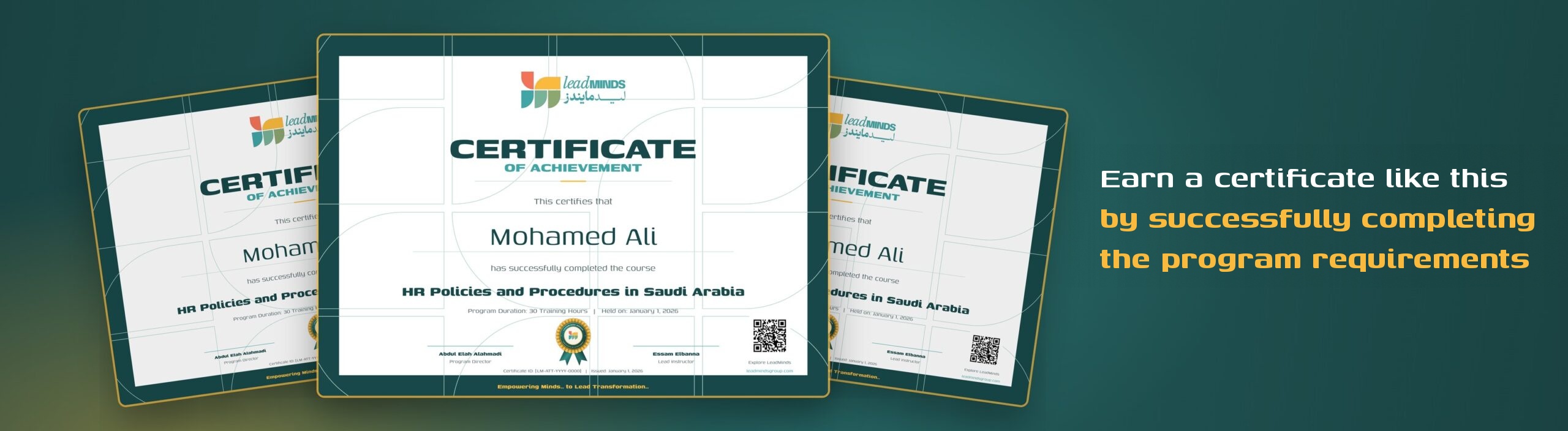
Certificate of completion
FAQ
1. When will my registration be confirmed?
Registration is confirmed once all program requirements have been met, full payment has been received, and seats are available.
2. What are the requirements to receive a Certificate of Completion?
Participants must attend at least 75% of the total training hours and complete the portfolio (ten practical deliverables), the 60-question knowledge assessment, the integrative activity and the aPHRi®-style mock exam.
3. Can I cancel my registration and request a refund?
Yes, subject to the following conditions: 5 or more calendar days before the program starts: A full refund, less any non-refundable payment processing fees, if applicable. Less than 5 days before the program starts or in the event of a no-show: A 50% deduction from the program fees, subject to any additional non-refundable third-party charges. After attending more than 50% of the program hours: No refunds, deferrals, or transfers of registration are permitted.
4. Can I defer my registration to another date?
Yes, subject to seat availability and scheduled program dates: - 5 or more calendar days before the program starts: No additional fees. - Within the 4 calendar days preceding the program start date: A 10% administrative fee applies. - Deferrals are permitted only once and are not available after attending more than 50% of the program hours.
5. Can I retain my fees as training credit?
Yes. Participants may request to convert the refundable amount, as determined under the Refund Policy, into training credit valid for 12 months from the date of approval. Registration fees may be transferred to training credit only once, and the credit is non-transferable to another individual.
6. What happens if LeadMinds cancels the program?
Participants may choose between: - A full refund of the program fees paid, without any deductions by LeadMinds. - Converting the full amount paid into training credit toward another program.
7. Can I receive a refund if I paid through Tamara?
Yes. Refunds are processed in accordance with the Cancellation and Refund Policy, subject to the deduction of any non-refundable installment or processing fees under the payment provider's terms and conditions.
8. How long does it take to receive a refund?
Refund processing times vary depending on the payment method: - Mada and credit cards: Typically 7–14 business days. - Tamara and JeelPay: 3–21 business days, depending on the payment provider's procedures.
9. How can I submit a cancellation, refund, or deferral request?
Requests must be submitted in writing to info@leadmindsgroup.com, including the participant's name, program name, registration details, and reason for the request. The LeadMinds team typically reviews and responds to requests within 2–3 business days.
10. How does LeadMinds protect my personal data?
LeadMinds is committed to protecting personal data in accordance with the Saudi Personal Data Protection Law (PDPL). Personal data is used only for purposes necessary to provide services, process registrations, issue certificates, and communicate with participants. LeadMinds does not sell personal data to third parties.